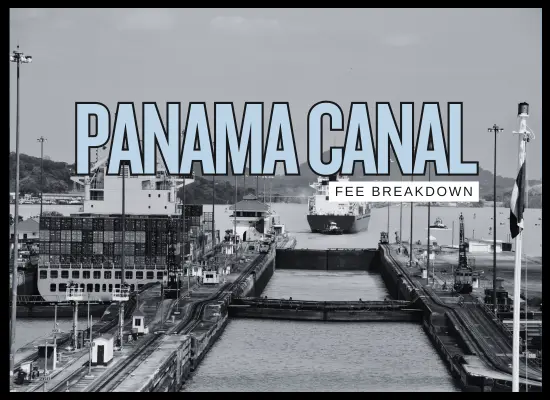
Panama Canal “fees” are really a stack of costs that hit you in different ways: the toll itself, the slot you need to make the schedule work, and the penalties that show up when weather, congestion, or a late arrival forces a change. Going into 2026, the important part is not memorizing every tariff line. It’s understanding what actually drives the number for your vessel type and how reservation choices can swing the total from a routine transit expense to a six-figure scheduling bill.
⏱️ 2-minute summary: Panama Canal transit fees in 2026▶
Use this as a briefing sheet. Each row shows the fee driver, the billing logic, and what typically
causes the invoice to move.
#
Fee driver
How it is billed
What operators feel
1️⃣
Start with size category
Regular vs Super vs Neopanamax drives which tariff bands and reservation lane apply.
Edge cases can be treated as Neopanamax for toll assessment if routed through those locks.
The same ship can be “priced” differently if it ends up using different locks. This is where early planning misses happen.
2️⃣
Two-part toll structure
Toll is built from a fixed component per transit plus a capacity component tied to your vessel class and billing unit.
If you only model “toll per transit,” you can miss the variable component that scales with TEU, PC/UMS, DWT, or m³.
3️⃣
Fixed component step-ups
A set USD amount per transit that changes by size category and sometimes by class thresholds (example: container TEU cutoffs).
The fixed piece sets the “floor.” Neopanamax fixed levels can shift the total even before adding capacity charges.
4️⃣
Container toll math is TEU-driven
Container toll proxy is fixed plus TEU capacity (TTA), TEU loaded (TTL), TEU empty (TTE).
TTL rate can step up for larger Neopanamax capacities.
Small input errors (capacity or onboard split) can swing the estimate. It is usually the fastest to model once inputs are clean.
5️⃣
Non-container billing units
Many classes bill on PC/UMS, dry bulk often on DWT/TDWT, LNG and LPG on cargo capacity (m³).
Two Panamax ships can have very different Canal bills because their capacity component is measured differently.
6️⃣
Ballast factor
For many non-container classes in ballast, tolls may be assessed as a percentage of the laden toll (a common proxy is 85%).
Ballast vs laden status can materially shift the toll line, but the exact applicability is rule-based by class.
7️⃣
Standard reservation fees
A separate scheduling layer: Panamax reservations by Regular or Super; Neopanamax reservations have their own band.
In stable schedules it is predictable. In tight weeks it becomes a real voyage cost driver.
8️⃣
JIT service and high-demand effects
Optional service fees and designated-day surcharges can apply on top of standard reservations, especially in Neopanamax lanes.
Calendar choice and timing discipline matter. The same toll can pair with very different scheduling costs.
9️⃣
LMTR: last-minute slot pricing
If a vessel arrives without a standard slot and gets assigned via last-minute method, the fee is a separate schedule salvage charge.
The toll might be normal, but the booking method turns into a major add-on when arrival timing is uncertain.
🔟
Cancellation is where surprises concentrate
Standard cancellation bands rise as you get closer to the required arrival time.
Very late cancellation can add an extra surcharge. LoTSA cancellations follow bid-based rules.
Canal spend can swing from “toll-driven” to “schedule-driven” fast when plans move inside short windows.
Bottom line: the toll is mostly formula-driven once your vessel class inputs are clean. The scheduling layer is where timing shifts turn into large, fast-moving costs.
Canal Cost Estimator
Panama Canal costs going into 2026 are easy to underestimate because they come in two layers: the transit toll (which depends on your vessel type and the Canal’s measurement unit for that type) and the scheduling layer (reservation, just-in-time service, or last-minute slot pricing). The calculator below gives a practical estimate you can tweak in seconds, so you can see which inputs actually move the number.
Many vessel types use PC/UMS. This estimator applies the published per-PC/UMS rate for your vessel class.
Dry bulk capacity component is estimated using the published per-DWT/TDWT tariff rate.
LNG and LPG capacity component is estimated using the published per-m³ tariff rate.
Ballast transit (proxy)
Applies an 85% factor to the toll estimate (not applied to container ships in this calculator).
Optional scheduling layer
Add Just-in-Time service fee
Uses the published JIT service fee for the selected locks.
High-demand day surcharge (Neopanamax only)
Applies a 10% surcharge to the Neopanamax reservation fee when designated.
Optional: estimate cancellation fees
LoTSA cancellation fee is estimated as 80% (15+ days) or 100% (<15 days) of the awarded bid amount.
Standard reservation cancellation estimate uses the published percentage schedule.
If cancellation is under 2 days, this estimator also adds the published late cancellation surcharge (proxy).
$0
Estimated total: toll + selected scheduling items
Estimated toll
$0
Reservation / scheduling
$0
Fixed component
$0
Capacity component
$0
Cancellation estimate
$0
Notes
Change inputs to see what moves the result.
This is an estimator using published tariff components and common proxies. It does not include tug/pilotage, agency, port dues, bunkers, war risk, delays, or any special assessments not selected above.
Always verify with the current ACP tariff and your booking channel before fixing a voyage.
Panama Canal pricing starts with a simple question: what “size category” does your ship fall into for Canal purposes. That category usually determines which locks you can use, which reservation lane applies, and in some cases which toll schedule you land on, especially when a Panamax vessel ends up transiting Neopanamax locks due to draft or a deficiency.
Panama Canal Vessel Size Categories (Used for Fees and Booking)
These categories are the practical “gateway” to toll and reservation rules going into 2026.
Size category
Trigger dimensions
Lock routing you should assume
Fee impact you feel first
Regular (Panamax)
Beam less than 27.74 m (91 ft)
Panamax locks in the normal case
Lower standard reservation fee band and regular-vessel toll schedule.
The biggest swing comes from what unit your ship type is billed on (TEU, PC/UMS, DWT, m³).
Super (Panamax)
Beam equal to or greater than 27.74 m (91 ft)
Panamax locks, but with “Super” handling in tariffs
Higher standard reservation fee band than Regular.
Fixed toll component and some capacity rates also change versus Regular.
Neopanamax
Beam greater than 32.61 m (107 ft) and/or length greater than 294.44 m (966 ft)
Neopanamax locks by definition
Neopanamax reservation and LMTR fees apply.
Fixed toll component typically steps up sharply, and the capacity tariff uses the Neopanamax rate schedule.
Important edge case
Panamax ship transits Neopanamax locks due to draft above 39.5 ft or due to a condition/deficiency
Routed through Neopanamax locks even if “Panamax sized”
Treated as Neopanamax for toll assessment in that scenario.
This is one of the easiest ways for planning estimates to miss the true cost.
Tip for readers: size category is the first filter, but vessel type decides the billing unit. A Panamax bulker and a Panamax container ship can have very different toll math even at the same “size category.”
A Breakdown of Panama Canal Fees
Most Canal cost surprises come from mixing together two different things: the toll (a fixed amount plus a capacity-based charge tied to your vessel class) and the scheduling layer (reservation and related fees, handled in the next section). This breakdown shows exactly what makes up the toll math going into 2026, and which inputs actually move the number.
Panama Canal Fee Breakdown (Toll Components)
Basis: ACP toll tariff structure in effect going into 2026 (fixed component + capacity component, plus specific container TEU components).
Fee piece
What it is
How it is billed
Numbers owners look for
Canal toll (the core)
The toll is built from two parts: a fixed tariff component per transit, plus a capacity tariff component that depends on vessel class.
Container ships have TEU-based capacity and onboard TEU components.
Per transit, plus per-unit charges (TEU, PC/UMS, DWT, or m³ depending on class)
Focus on: fixed component plus the rate x your billing unit.
Fixed component
A fixed USD amount per transit. It changes by size category and, for some classes, by thresholds (examples: PC/UMS cutoffs, container TEU cutoffs).
One fixed amount per transit
Regular: $15k, $25k, or $60k (depends on vessel class thresholds)
Super: $100k
Neopanamax: $200k (some container cases) or $300k
Capacity component (non-container)
The variable part. ACP applies published per-unit rates by vessel class and size category. This is where “same locks, different ship type” creates very different totals.
Container toll math is TEU-driven and typically includes TEU capacity (TTA), TEU loaded onboard (TTL), and TEU empty onboard (TTE), plus the fixed component.
Neopanamax TTL rate steps up when TEU capacity is above 10,000.
If a non-container vessel carries containers on deck, ACP can apply additional per-TEU charges by container type.
Per TEU on deck (by category)
Refrigerated: $120 per TEU
Dry: $110 per TEU
Empty: $70 per TEU
Ballast factor
For many non-container vessel types transiting in ballast, tolls can be assessed at a reduced percentage versus laden tolls.
Percentage adjustment (rule-based)
Common planning proxy: 85% of laden toll (non-container classes)
Scheduling layer (separate)
Reservation fees, JIT service, LMTR pricing, and cancellation costs are not part of the toll math.
They are a separate operational fee layer that can materially change total Canal spend when plans move.
Reservation and service fees (per booking or action)
Covered in the next section: Reservation and Cancellation Fees.
Note: This breakdown focuses on ACP Canal-side tariffs. It excludes tugs, pilotage outside Canal scope, agency fees, port dues, bunkers, delay costs, and any commercial arrangements not published in the tariff schedule.
Reservation & Cancellation Fees
Panama Canal scheduling costs are where “routine” transits can turn expensive fast. The base reservation fee is usually predictable, but the real swing comes from what happens when you change dates, swap slots, substitute vessels, arrive late, or cancel inside short notice windows. This table lays out the main reservation and change-fee items that shape costs going into 2026.
Panama Canal Reservation and Cancellation Fees (Transit Reservation System)
Currency: USD. Focused on reservation, scheduling, and change or cancel scenarios that affect voyage economics.
Bucket
Fee item
Applies to
Amount
How it shows up in ops
Base booking costs (the slot itself)
Reservation
Standard transit reservation
Panamax locks (Regular / Super)
$12,000 / $50,000
The baseline “slot cost” for most planned transits.
Reservation
Standard transit reservation
Neopanamax locks
$100,000
Bigger schedule premium before any auction or LoTSA bid is involved.
Service add-on
Just-in-time service (JIT)
Panamax locks / Neopanamax locks
$4,000 / $10,000
Helps protect sequence timing, but noncompliance can still trigger separate penalties.
Surcharge
High-demand day surcharge
Neopanamax reservation on designated high-demand day
10% of reservation
A calendar effect that can change the total even when toll math is unchanged.
Alternative access
Last-minute transit reservation (LMTR)
Regular / Super / Neopanamax
$25,000 / $100,000 / $200,000
The “schedule salvage” price when you arrive without a standard slot.
Optional
Transit date advancement request
Panamax booked vessel / Neopanamax booked vessel
$5,000 / $10,000
A paid “pull it forward” request when you need earlier transit timing.
Changing the plan (fees that appear when timing or vessel assignment moves)
Change
Reservation date change
Notice window before required arrival time
60% (over 21 to <60 days)
70% (over 7 to 21 days)
80% (over 4 to 7 days)
100% (4 days or less)
The “I need a new date” cost gets steep inside three weeks.
Swap
Swap reserved slots between two booked vessels
Up to 5 swaps per transit itinerary
Included (more than 14 days)
1% of reservation (14 days or less)
Useful inside liner networks, but short-notice swaps still carry a charge.
Substitution
Substitute a booked vessel with a non-booked vessel
Notice window before required arrival time
$500 (over 30 days)
20% (over 14 up to 30 days)
40% (over 7 up to 14 days)
60% (over 4 up to 7 days)
80% (4 days or less)
A common real-world scenario when a string changes and you want to preserve the slot.
Cancellation and penalties (where the big surprises happen)
Cancellation
Standard reservation cancellation schedule
Notice window before required arrival time
50% (over 90 days)
60% (over 21 up to 90 days)
70% (over 7 up to 21 days)
80% (over 4 up to 7 days)
100% (4 days or less)
The closer you are to the slot, the closer the fee gets to “full price.”
Surcharge
Late cancellation surcharge
Cancellation with less than 2 days to required arrival time
250% of reservation tariff (in addition to cancellation fee)
The sharp edge of the system. Small timing slips can become very expensive here.
Late arrival
Same-day transit fee if reservation is lost due to late arrival
How late you arrive
25% (up to 1 hour)
50% (over 1 up to 2 hours)
100% (over 2 hours)
50% (JIT noncompliance)
This is the “missed the window” cost layer. It is separate from the toll.
LoTSA 2.0
Cancellation fee for Long-Term Slot Allocation (bid-based)
Notice window before required arrival time
80% of awarded bid (15 days or more)
100% of awarded bid (less than 15 days)
Works like “priority you purchased.” Cancel timing determines how much of that spend is recoverable.
Note: Auction and LoTSA bookings are “best offer” based. This table highlights the fixed tariffs and the most common change or penalty schedules that affect total Canal spend.
Going into 2026, the Panama Canal cost story is less about a single “toll number” and more about how predictable your transit plan is. The toll components are largely formula-driven once you know the vessel class and billing unit, but reservation behavior, timing changes, and short-notice cancellations can quickly become the bigger line item. For most readers, the practical takeaway is that two voyages with the same origin and destination can produce very different Canal bills depending on how the slot was secured and how stable the arrival window stayed.